.png)

.png)
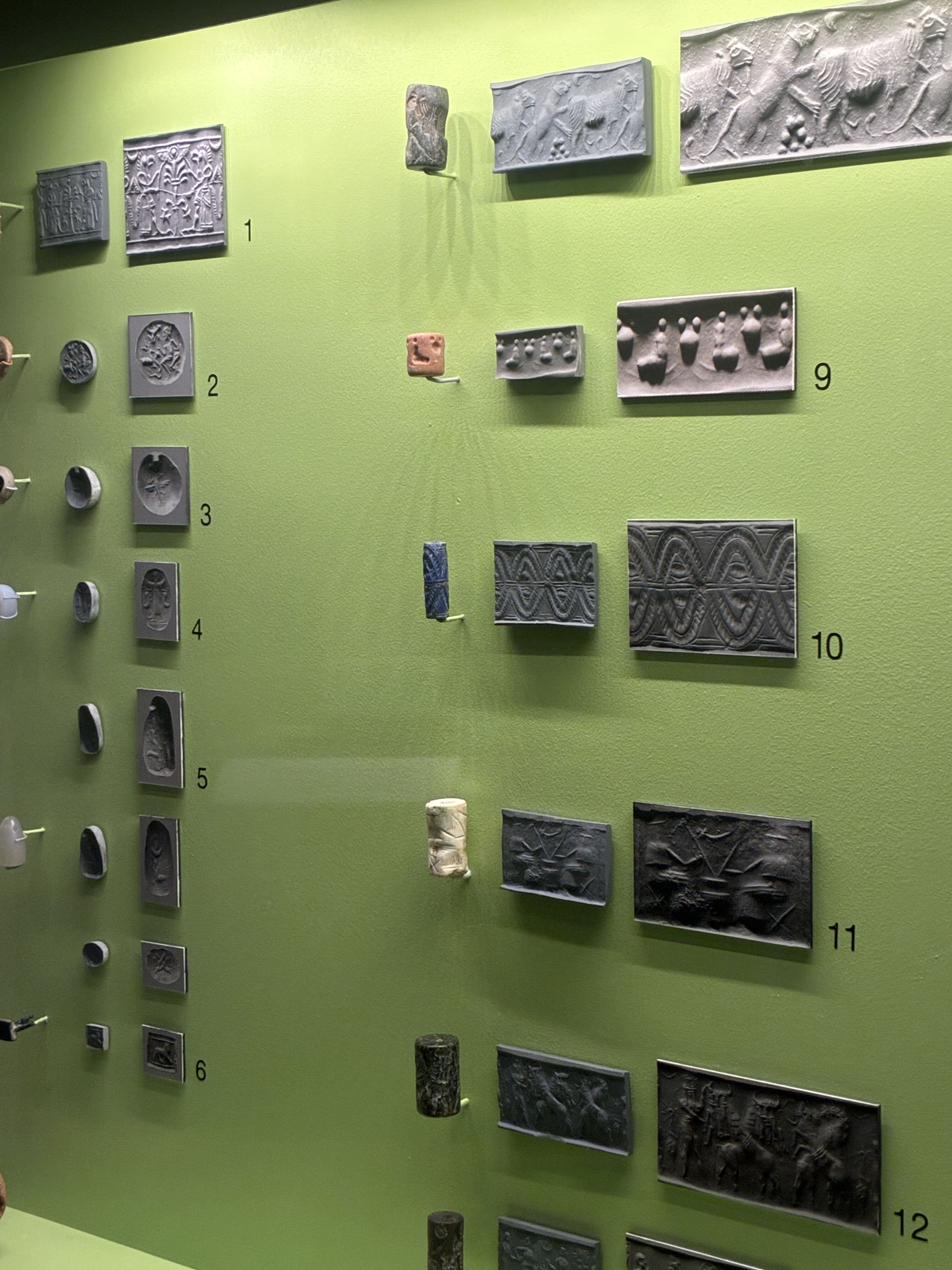
This photo shows rows of stamp and cylinder seals from the ancient Near East. While a seal would certainly be what closes or secures a document or parcel (see Rev 5:2),it works not merely by securing but by imprinting. Soft clay or wax would be applied to a surface, then the seal pressed into it, then the clay or wax would harden keeping the image. So, it was not just the adhesive capacity of the clay or wax but the unique alteration of the soft material that made something “sealed.”
Our archaeological reflection today will survey the variety of functions these seals served. Understanding the multiple uses—both literal and metaphorical—for these works of art may help us appreciate biblical passages that use the language of being“sealed.” Additionally, we must remember that these different purposes are not mutually exclusive. The biblical references to seals and sealing may draw on more than one of these connotations.
1. Seals were used for authorizing and granting authority. For example, in 1 Kings 21, Queen Jezebel writes letters with her husband Ahab’s royal seal, giving instructions for the murder of Naboth. In the story, we get the sense that her diabolical scheme would nothave been carried out—or carried out so easily—without this symbol of kingly authority.
2. Showing a seal would establishownership or identity (kind of like a cattle brand or tag). It could markproperty or distinguish a person or project as connected with someone ofinfluence. Romans 4:5 suggests this in describing Abraham’s circumcision as aseal of righteousness. When we read on, we see that this seal establishes andconfirms his and his descendants’ identity as belonging to God in a specialway.
3. A seal was also used to confirm promised future action. For example, in Gen 38, Jacob’s son Judah promises to send a prostitute (plot twist: it was his daughter-in-law in disguise!) his promised payment for her services. The ring that bore his seal carried intention or guarantee of his integrity. In the New Testament, we read about the Holy Spirit as the seal—or downpayment—of God’s final and ultimate redemption (2 Cor 1:22; Eph 1:13)
4. When not performing their stamping function, seals were frequently worn as amulets to protect the wearer from evil spirits (and probably also letting other humans know that if harm comes to them, there is someone higher up that will care!). We see something of this inRevelation 7:3-4, where the worshipping multitude is marked with God’s seal so as to not be harmed in the coming destruction.
5. These were also works of art and expression. While it was common for them to be made of stone or metal, they were also made of gems. The quality of the seal’s material often made just as much an impression (pun intended) as the image itself. In this way, a seal could serve as a kind of jewelry or accessory. In the Book of Sirach, the author admonishes the reader to respect the artisans who make beautiful seals to be worn and displayed (38:27).
We usually think of our signatures as our modern seals, but seals in the ancient world would rely far more on imagery than verbiage. When you look at the seals pictured here, you will notice geometric patterns, animals, and pastoral and social scenes. This challenges us to think about being sealed by God in terms of an image rather than words. So much of our society’s understanding of faith focuses predominately on words: Scripture, song, creeds, etc. Perhaps asking us to visualize representations of faith and describe devotion in pictorial modes would help us gain clarity and therefore discernment and further expression in matters of faith and life.
Go deeper with courses, podcasts, and resources from The Candler Foundry, taught by scholars who bring the Bible to life for everyday faith.
Browse all content